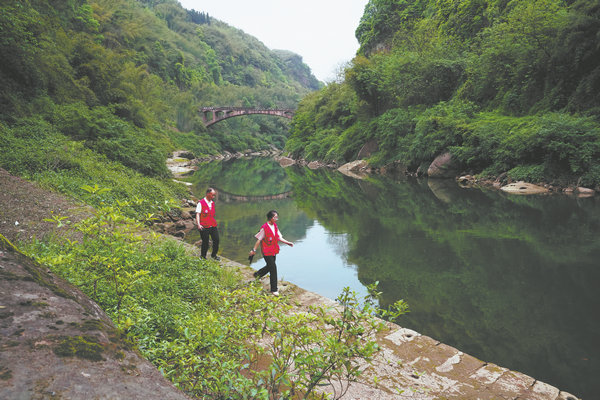
While tracing the stone capstan that trackers used to moor their boats along the Yongning River in Xuyong county, Luzhou, Sichuan province, Liu Xin and his colleagues made a serendipitous discovery of the Ancestral Temple of Caogong.
It was recorded in the local county annals for centuries but never physically located until March, when the county team was doing fieldwork of the ongoing fourth national census on cultural relics in China.
Caogong refers to the Ming Dynasty (1368-1644) official Cao Zhen, who followed the government decree to undertake the task of building Jiangmen Gorge to tame the river's dangerous rapids and reefs.
In 1550, to commemorate Cao's achievement, the Sichuan provincial governor ordered the construction of the ancestral temple, which was finished seven years later.
The 57-year-old Liu recalls that he first stumbled upon a heavily weathered stone tablet whose inscription had eroded.
His instinct suggested further relics might be present nearby, so he prompted the team to expand the search area.