
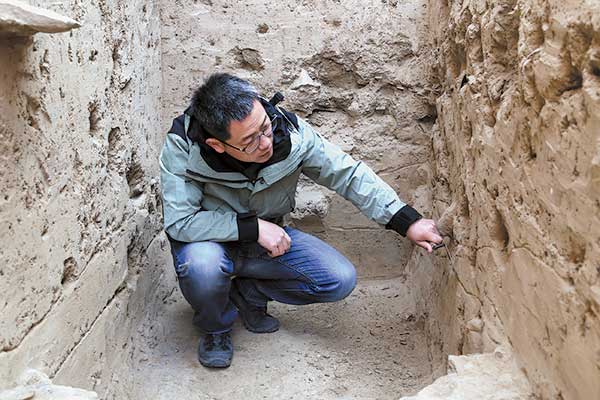
It was decided in 2022 that the kilns in Chencun to be excavated. Archaeologists from the Shanxi Provincial Institute of Archaeology, Peking University, Fudan University and Huozhou city's cultural relics department conducted investigations and explorations of the village. They finally chose eight sites covering 600 square meters for excavation, Liu, who is in charge of the excavation team, says.
The findings of the porcelain kilns in Chencun village fill an archaeological gap, Liu says.
The Song Dynasty (960-1279) is always referred to as the golden age of Chinese ceramics. During this period, the degree of specialization at the different kiln sites increased and the demand for particular wares began to rise among specific social classes.
This is especially evident in the existence of the famous "five kilns": the Ru (Henan province), Guan (Zhejiang province), Ge (Zhejiang province), Jun (Henan province) and Ding (Hebei province).
While it had been widely believed that North China did not produce white porcelain wares when the Jin Dynasty ended, the discovery of the Huozhou kilns site in Chencun showed that white porcelain was fired in North China until the Ming Dynasty.