



Restorers breathe life into ancient books









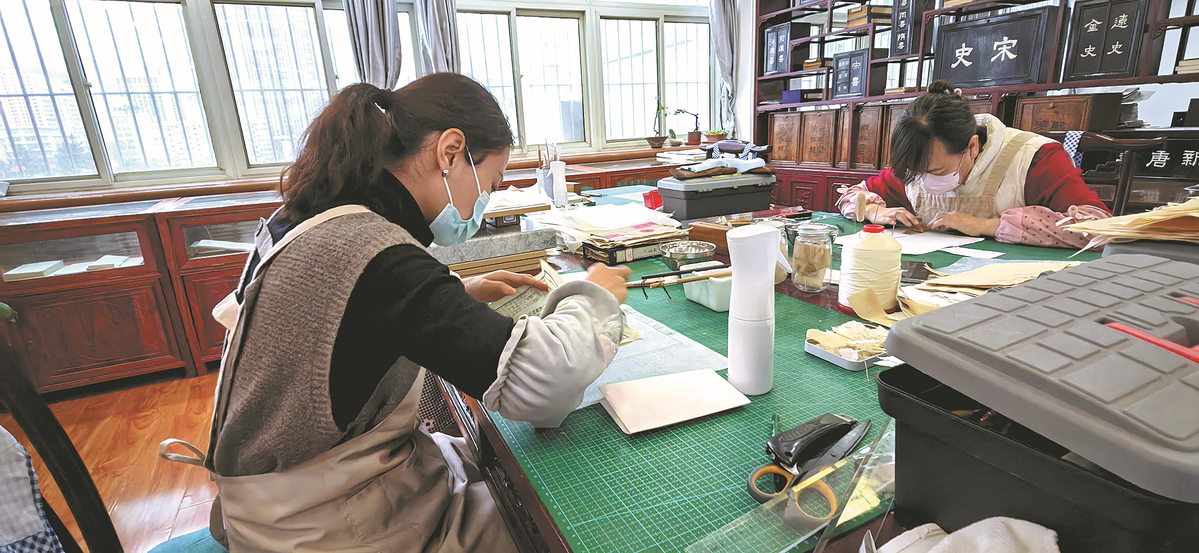
LANZHOU — With a pair of tweezers and a brush in hand, Yao Jiadi, who specializes in restoring ancient books, delicately navigated through damaged pages to mend the fragmented gaps.
On her table, pens, brushes, needles and other tools were neatly laid out alongside timeworn works in need of restoration. Some books were as stiff as bricks, while others had pages as thin as cicada wings.
With their unique techniques, restorers substantially extend the lifespan of these cultural treasures. In 2008, restoration techniques for ancient books were listed as a national intangible cultural heritage.
Yao, 35, works at the Tianshui Library in the northwestern province of Gansu. For her, ancient book restoration is both a window into the past and a race against time.
"Restoring ancient books is like performing a micro-level surgery on them. It requires preoperative diagnosis and planning," she said.
Before restoration, she and her colleagues conduct comprehensive inspections and analyses of the books. Based on the specific conditions of each book, they formulate targeted restoration plans to address various kinds of damage such as insect or mouse bite marks, mold and loss of adhesion.
Yao, who has been restoring books for more than six years, recalls the first restoration she ever completed.
"There were not many pages in the book, but every page was covered in mud," she said. "Many pages were damaged, and the cover and bookmarks were stuck together."
After over a month of meticulous efforts, the ancient book now looks as good as new.
Ancient book restoration involves over 20 intricate processes. The work can be arduous, so when they find interesting content in the books, restorers take a break and set aside their work to engage in a lively discussion.
Li Donghui, deputy director of the Tianshui Library, is an inheritor of ancient book restoration techniques. He emphasized that such work is not merely a mechanical task but a job that requires knowledge in related disciplines and a certain level of creativity.
With a background in fine arts, Li has a passion for bookbinding. He once restored a fragile ancient book from the Ming Dynasty (1368-1644) by adding white rice paper between pages to protect them, a creative binding method.
"I cherish ancient books like I cherish my own children. The sense of responsibility to protect them and the sense of accomplishment in restoring them are the sources of my passion for work," he said.
Since a national-level project to protect ancient Chinese books was launched in 2007, six catalogs of national precious ancient books have been released. About 13,000 ancient books are on the list, including five housed in the Tianshui Library.
Today, ancient book restorers across China are exploring new ways to revitalize ancient books, with digitization emerging as a crucial means to balance preservation and utilization.
In recent years, Tianshui Library completed the digitization and reproduction of two precious ancient books, achieving the dual goals of preservation and utilization of the works.
Xinhua


- Top work safety body to conduct nationwide assessments and inspection tours after Spring Festival holiday
- Moviegoing becomes a popular new tradition during Spring Festival holiday in Xinjiang prefecture
- Forest and grassland fires fell to a record low in 2025
- Miao ethnic group celebrates Tiaohua Festival in Guizhou
- Chinese courts wrapped up 168,000 maritime cases during the 14th Five-Year Plan period
- China strengthens forest, grassland fire prevention, control








